To check an Upgrader result yourself, you need the inputs behind the round and the exact calculation that produced its outcome—not just an animation or a fairness label. Upgrader offers Upgrade and Battle modes, with Steam sign-in for upgrades. However, its published product description and terms do not explain a reproducible seed-to-result calculation. This guide separates those documented features from the general cryptographic checks you should expect, explains how to verify a result when the necessary records are available, and shows when you must leave a result unverified. Chance-based skin games are 19+ and carry a house edge.
Can you independently verify an Upgrader result?
Independent verification requires a complete chain: a commitment fixed before the relevant inputs become known, the disclosed inputs afterward, a published calculation and a recorded result to compare against. Upgrader’s public product description and terms do not specify its hashing algorithm, seed format, round counter, outcome-mapping formula or a public verifier address. You should therefore not assume that a generic provably fair calculator can reproduce an Upgrader round.
That distinction matters: an undocumented method is not proof that an individual outcome was manipulated, but it is also not enough to establish independent verifiability. A screenshot of a successful upgrade, a losing streak or a displayed hash cannot settle the question alone. The practical test is whether you can reconstruct the same result from previously committed data without relying entirely on the operator’s own verdict.
| Subject | What Upgrader documents | What a fairness check additionally needs |
|---|---|---|
| Upgrade | The site describes upgrading CS2 items. | The inputs, random-result calculation and rule connecting the result to success or failure. |
| Battles | Users can create, join or watch 2-player battles. | The input assignment, result-generation sequence and final comparison rules. |
| Account access | Users sign in through Steam to access upgrades. | A separate verification method; Steam sign-in does not authenticate game randomness. |
| Seed commitments | The product description and terms do not specify a commitment scheme. | The original commitment, its timing and the exact hash procedure. |
| Result reproduction | The product description and terms do not set out a reproducible result formula. | A complete specification, disclosed inputs and an independent calculation. |
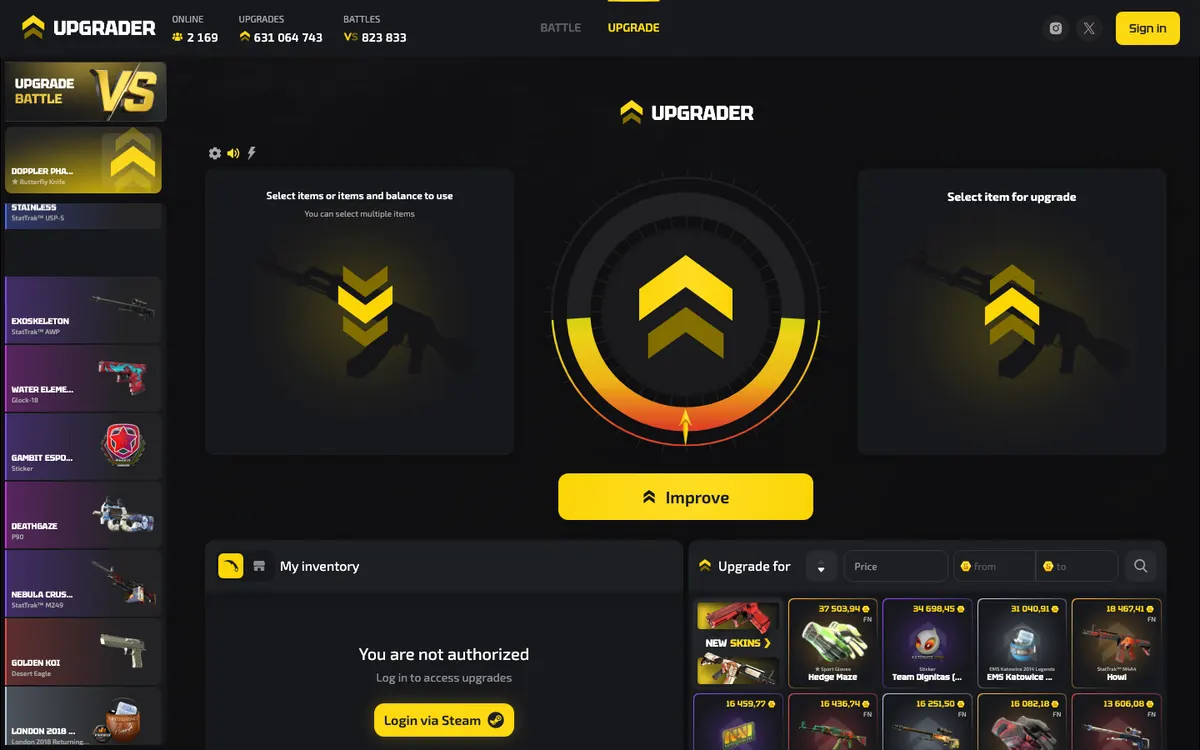
The official Upgrader homepage describes the product, while the User Agreement sets out platform terms. Neither the appearance of the interface nor the existence of terms substitutes for round-level cryptographic evidence.
Understand seeds, hashes and round counters
The following concepts describe a common commitment-and-reveal design. They are a framework for assessing a published system, not a description of an established Upgrader implementation. A different design can also be verifiable, but it must explain how it prevents relevant inputs from being changed after the outcome becomes predictable.
Server seed: the operator’s secret input
A server seed is data generated on the operator’s side. In a common design, it remains secret while it is active, because revealing it too early could make future results predictable. The operator first publishes a cryptographic commitment to that seed. After the seed is retired, the original value can be revealed so past results can be checked. Verification depends on the revealed value matching the earlier commitment, not merely on a seed appearing in the history after play.
Client seed: an input outside the operator’s sole control
A client seed is commonly supplied or changeable by the player. Its purpose is not to make a lucky result more likely. It helps prevent the operator from choosing the entire input combination alone, provided the commitment sequence is properly designed. Timing is essential: the server commitment should already be fixed before the player supplies the relevant unpredictable input. If the operator can choose its seed afterward, a client-seed field does not by itself establish fairness.
Hash: a commitment, not a result certificate
A cryptographic hash produces a fixed-format digest from input data. It should be practical to compute the digest but infeasible to recover a suitably unpredictable secret input from it. Once the seed is revealed, you can hash it again and compare the output with the saved commitment. A match supports the claim that the revealed seed fits that commitment. It does not independently prove when the commitment was published, whether the seed was chosen appropriately or whether the displayed outcome followed the advertised rules.
Nonce: keeping rounds distinct
A nonce is often a counter that changes between rounds using the same seed pair. It lets a deterministic calculation produce different inputs for different rounds. Some designs also use a cursor or another index for multiple draws within a round. The exact incrementing rules matter: a correct seed with the wrong nonce can reproduce a different result perfectly. A round identifier and a nonce may be separate fields, so never substitute one for the other without documentation.
Result mapping: turning random data into an outcome
A hash or keyed hash produces data, not an upgrade decision by itself. The implementation must turn that data into a usable value, then apply the game rules. This might involve reading part of a digest, converting bytes into a number and testing that number against an interval. Each operation needs a precise definition. Without the conversion and comparison rules, matching a hash stops short of verifying the actual win-or-loss decision.
Save the evidence before trying to verify
A useful verification record links the state before a round with the information disclosed afterward. Saving only the final result loses the timing evidence that makes a commitment meaningful. If an interface supplies fairness information, preserve its original text rather than retyping it. Screenshots help show context, but copyable records are better for calculations because an unnoticed character change can invalidate the comparison.
- Save the server-seed commitment as displayed before the relevant round, with enough context to identify when it was active.
- Record the exact client seed, including capitalization, spaces and punctuation.
- Keep the round identifier, mode, nonce and any additional draw index supplied by the interface.
- Preserve the displayed chance or outcome interval, selected inputs, target item and any rule settings relevant to the decision.
- Save the final result and its connection to the same round record.
- Keep the later server-seed reveal and the published algorithm version used for that round.
- Retain original exports where available; avoid replacing them with edited screenshots or manually reconstructed summaries.
How to verify a result when the full method is available
Use this procedure only with the actual specification for the platform and mode concerned. It is not an Upgrader-specific calculator. A verifier designed for another site may accept similar-looking seeds while using a different message format, digest selection or outcome range. Plausible output is not enough: the calculation must reproduce the documented procedure exactly.
- Identify the exact round and rulesStart with the round identifier, mode and rule version. Confirm that the displayed result, seed record and chance settings belong together. If a platform changes its algorithm, checking an older round with the current rules can produce a mismatch even when the records themselves are intact. Preserve the historical specification whenever it is available.
- Check that the commitment came firstCompare the saved pre-round commitment with the record associated with the revealed seed. A commitment shown only after the result cannot demonstrate that the operator was bound beforehand. Also check the order in which player-controlled inputs were selected. The design should prevent a party from choosing its input after learning enough to predict the outcome.
- Recompute the seed commitmentApply the documented hash procedure to the revealed server seed. Follow the required text encoding and input representation. Hashing visible hexadecimal text is not necessarily the same as hashing the bytes it represents. Compare the complete digest with the original commitment. If they differ, stop treating that seed as a successful match until the discrepancy is explained.
- Assemble the random-result inputs exactlyUse the documented seed order, separators, nonce format and any additional indices. If the method uses a keyed hash, follow its key and message assignments rather than treating it as ordinary concatenation. Do not trim spaces, change capitalization or swap field order unless the specification explicitly requires that transformation.
- Reproduce the raw random valueRun the specified calculation and inspect its intermediate output. Then apply the documented byte selection, number interpretation and scaling rules. If the method discards certain values and draws again to avoid bias, reproduce that step too. Agreement at an intermediate stage helps identify whether a later mismatch comes from conversion rather than seed handling.
- Apply the outcome ruleCompare the reproduced value with the exact success interval, item-selection rule or battle procedure. Check whether boundaries are inclusive or exclusive and whether rounding happens before or after the comparison. A rounded display can look inconsistent with a correctly calculated raw value, so the specification must identify which value controls the decision.
- Compare with an independent implementationWhere practical, reproduce the calculation in a separate local implementation or a transparent verifier whose code you can inspect. A platform-hosted checker is convenient, but its approval alone is weaker than reproducing the same result independently. Never provide a Steam password, session cookie, authenticator code or trade authorization to a fairness calculator.
- Record the conclusion narrowlyState exactly what matched: the commitment, random value, outcome mapping or complete round calculation. If a required input or rule is unavailable, mark the relevant stage unverified. A successful check supports consistency for that recorded round under the stated method; it does not certify the operator’s entire history, withdrawals, account security or legal status.
Check the outcome mapping—not only the hash
The most easily overlooked part of verification is the bridge between random data and the game result. A digest can match while the wrong success interval is applied. Likewise, a displayed chance may be rounded for readability while the underlying calculation uses a more precise threshold. You need the rule that actually determines the outcome, not an assumption based on the animation.
| Detail | Why it changes the calculation | What to look for |
|---|---|---|
| Input encoding | The same visible characters can be converted into different byte sequences. | An explicit character encoding and rules for interpreting encoded seeds. |
| Field assembly | Changing input order or separators changes the digest. | Exact key, message, concatenation and separator definitions. |
| Digest selection | Reading a different portion of the output produces a different value. | The selected bytes or characters and their interpretation. |
| Range conversion | A careless conversion can favor some values over others. | A defined mapping, including rejection rules where needed. |
| Decision boundaries | A value at an interval boundary can be classified differently. | Inclusive or exclusive comparisons and the order of rounding. |
| Rule version | A later implementation may not reproduce historical rounds. | The specification that applied when the round occurred. |
Range conversion deserves particular attention. Reducing a large set of possible random values into a smaller set can introduce bias if the larger set does not divide evenly into the smaller one. Some designs address this by rejecting values outside an accepted range and continuing with additional output. Other constructions use different documented methods. The important point is not to demand a particular technique, but to require a complete explanation that preserves the intended distribution.
What to check in Upgrade and Battles
Upgrade: connect the random value to the selected target
Upgrader documents an Upgrade mode, but its public product description and terms do not provide the mathematical decision rule. For any upgrade system, a complete check should connect the selected inputs and target to the chance or success interval fixed before the draw. It should then show that the reproduced random value falls on the same side of that boundary as the recorded result. Skin valuations and the random calculation are separate questions: matching a draw does not establish that the item prices used to set its terms were competitive. For mode context, see Upgrader game modes.
Battles: verify the full decision sequence
Upgrader lists battles that users can create, join or watch. Those features do not establish how battle randomness is generated. A verifiable multiplayer design must explain which inputs belong to which participant, when they become fixed and how any separate draws are ordered. If a battle contains several random decisions, checking a final hash without reconstructing that sequence can miss an incorrect assignment. The final comparison and any tie-handling rule also need documentation. Do not assume that a method suitable for a single upgrade automatically verifies a battle, or that the displayed winner alone reveals how the result was calculated.
Troubleshoot a missing or mismatched result
| Problem | Possible explanation | Next step |
|---|---|---|
| Only a hash is visible | A commitment may be displayed without the seed reveal or calculation rules. | Look for the retirement and disclosure procedure. Until the required data exists, leave the result unverified. |
| The revealed seed does not match | The wrong seed epoch, input encoding or copied value may be in use. | Compare the original records and exact hash instructions. Do not silently substitute another commitment. |
| The hash matches but the random value differs | The client seed, nonce, field order or keyed-hash construction may differ. | Compare intermediate outputs using the published input format. |
| The random value matches but the outcome differs | The discrepancy may be in thresholds, rounding, draw assignment or historical rules. | Check the original outcome mapping rather than rerunning only the hash. |
| A seed has not been revealed | It may still be active, or its disclosure process may be unclear. | Ask for the applicable reveal policy without staking additional items. |
| A third-party checker reports success | It may implement another platform’s algorithm or only check the commitment. | Confirm its supported method and identify precisely which verification stages it performs. |
| Results or counters look repeated | A displayed outcome can repeat, while counter behavior depends on the implementation. | Compare complete input records. Repeated outcomes alone do not demonstrate reused random inputs. |
When asking for clarification, describe the first stage where your calculation diverges. Include the round identifier, mode, relevant timestamps, saved commitment, disclosed seed, client seed, counter and method version where available. Explain whether you obtained a different digest, a different numerical value or a different final classification. That is more actionable than saying only that a round looked wrong. See Upgrader support guidance for preparing an account-related request.
Know what provably fair does not prove
Provably fair is not the same as favorable odds. A transparent random calculation can faithfully implement rules designed to favor the operator over repeated play. The house edge belongs to the game’s probability and reward structure; it is not removed by using hashes or player-selected seeds. Upgrader’s published product description and terms do not supply a numerical house-edge figure, so no specific edge or return figure should be inferred from this guide.
Nor does a matching calculation establish that every historical round was available for inspection, that item valuations were fair or that withdrawals will proceed as expected. A well-designed scheme should also address whether an operator can selectively cancel or omit rounds after learning their outcomes. Reproducing a saved round cannot by itself rule out omitted records. These are separate operational and audit questions, not problems solved simply by displaying a server-seed hash.
A losing streak is also not a cryptographic test. Random sequences can contain clusters, while a short sequence that looks balanced can still come from an unverifiable process. Statistical analysis and round reproduction answer different questions. Neither makes the next outcome predictable. Keep chance-based play within a pre-set entertainment budget, do not chase losses and consult responsible gambling guidance or ConnexOntario at 1-866-531-2600 if checking results becomes part of a cycle of continued play.
Keep fairness verification separate from Steam security
Upgrader uses Steam sign-in, but its terms state that the platform is not affiliated with or controlled by Valve or Steam. Steam authentication therefore should not be treated as Valve’s approval of a random-result system. Likewise, a successful fairness check cannot protect you from authorizing the wrong trade. Valve describes trade offers as exchanges with items selected for both sides, making the actual offer contents a separate checkpoint.
- Use disclosed historical round data for verification; a mathematical checker does not need your Steam account credentials.
- Never approve a trade, provide a mobile authenticator code or install a browser extension merely to calculate a hash.
- Inspect trade contents and the recipient independently of any fairness claim displayed on a website.
- Treat Steam delivery restrictions separately: a trade hold concerns item delivery, not the randomness of a game result.
- Avoid posting account-sensitive screenshots publicly when requesting help; share only the records needed to reproduce the calculation.
Valve explains that trade holds keep items with Steam before delivery so compromised-account owners have an opportunity to cancel fraudulent trades. That is a general Steam safeguard, not a documented Upgrader processing timetable. For account and item-transfer checks, use the separate trade safety guide. Upgrader’s terms also allow territorial and age-related restrictions, so availability and eligibility must be considered independently of technical fairness.
Quick checklist: decide whether the round is verifiable
- Can you identify the commitment that was fixed before the relevant round inputs became known?
- Do you have the matching disclosed seed and every other input used in the calculation?
- Is the exact algorithm published, including encoding, counters, conversion and outcome boundaries?
- Can you reproduce both the commitment and the final outcome independently?
- Are you using the rules and settings that applied to that specific round?
- Have you kept the conclusion separate from item pricing, withdrawal reliability, account safety and legal eligibility?
If a required answer is no, identify the missing stage rather than treating the whole process as verified. For Upgrader, the essential unresolved requirement is a published, reproducible seed-to-result specification with the corresponding round records. Generic explanations of seeds and hashes cannot replace that platform-specific evidence.
Upgrader provably fair FAQ
No matching questions found.
Is Upgrader provably fair?
Where is the Upgrader provably fair verifier?
How do I check a server-seed hash?
Can I verify a result before the server seed is revealed?
Does changing the client seed improve my odds?
Why does my calculation disagree with the displayed result?
Do Battles use the same fairness method as Upgrade?
Does provably fair mean an upgrade is safe or profitable?
This independent guide is for informational purposes and is not affiliated with Upgrader.